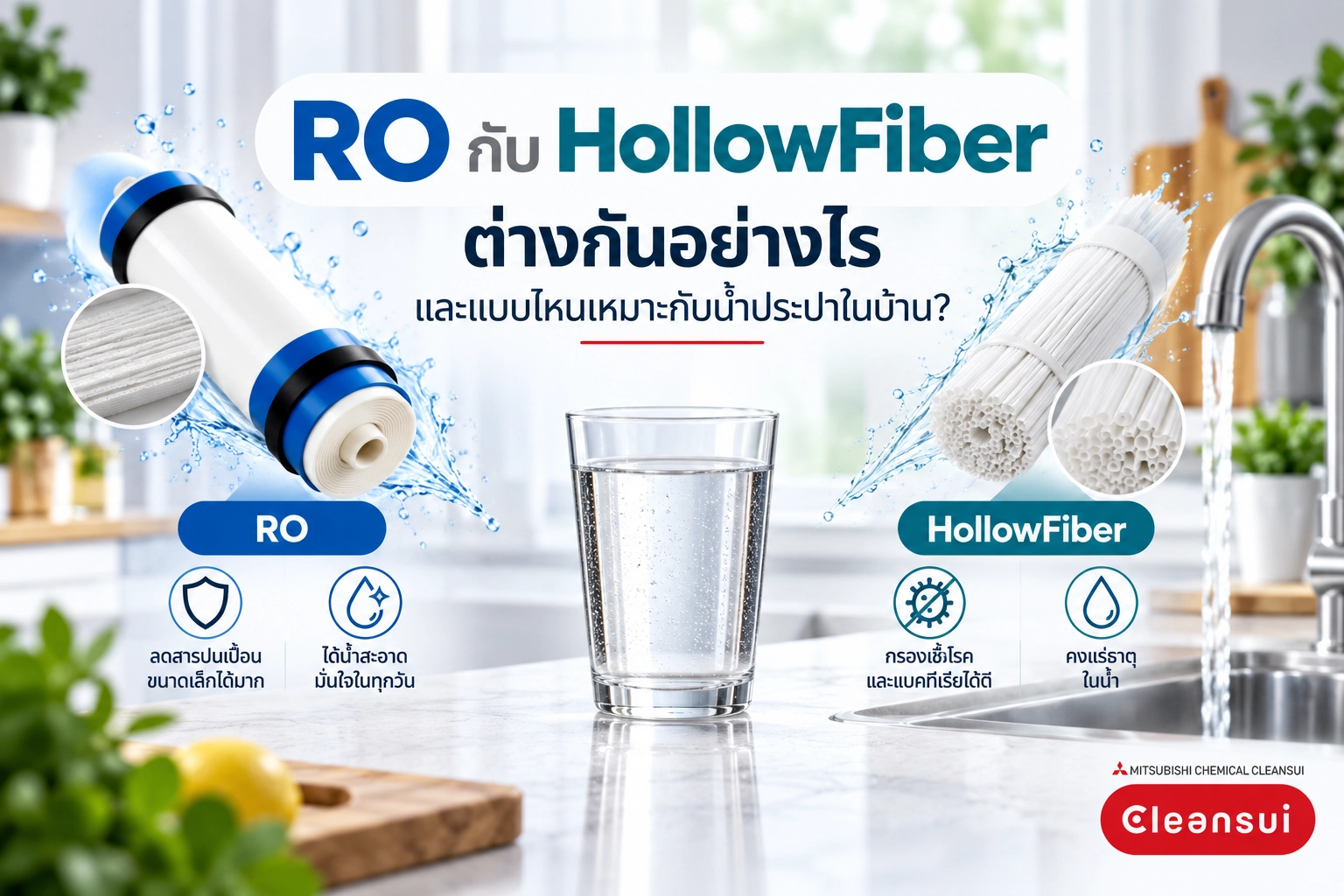
When it comes to home water purifiers, two of the most frequently compared technologies are RO (Reverse Osmosis) and Hollow Fiber, or Hollow-Fiber Membrane. Both use a membrane to separate contaminants from water, but they differ significantly in how they work, their pore size, what they can remove, and what happens to the water after filtering.
RO is a system that uses pressure to push water through a semi-permeable membrane, which can reduce dissolved substances, ions and extremely small contaminants. That makes it a technology with a high ability to reduce dissolved substances in water. But the process also removes some minerals, and it produces reject water that has to be drained away.
Meanwhile, Hollow-Fiber Membrane filtration passes water through tiny pores in the walls of tube-like fibers. It focuses on trapping particles and microorganisms according to pore size, while dissolved substances and some minerals can pass through. Cleansui uses this technology as one of the core elements of its filtration systems, and often pairs it with Activated Carbon to handle a different type of contaminant.
So the question “Which is better, RO or Hollow Fiber?” may not be quite the right one. A better question is “What problem does my home’s tap water have, and what do I want to remove from it?” If you want to substantially reduce dissolved substances, salts, ions or certain contaminants, RO may be the better fit. But if your tap water has already been through the municipal treatment system and you want to reduce chlorine, odor, turbidity, rust and certain microorganisms while keeping some minerals, a Hollow Fiber + Activated Carbon system may suit you better.
This article explains the differences between the two technologies, from how they work, their advantages and limitations, cost and water use, to how to choose for each type of home.
What Is RO?
RO stands for Reverse Osmosis. It works by using high pressure to push water through a semi-permeable membrane whose pores or passages are extremely small. Part of the water passes through the membrane and comes out as treated water, while many contaminants are held back and flow out with a separate stream called reject water, or concentrate.
According to the CDC, RO membranes have an approximate pore size of 0.0001 micron and can reduce many kinds of contaminants, including parasites, bacteria and viruses, as well as certain chemicals such as lead, copper, chromium, chloride and sodium, with actual performance depending on the system and the substance to be removed. That is why RO can reduce dissolved substances and Total Dissolved Solids, or TDS, more than membrane filtration systems with larger pores.
What Is Hollow Fiber?
Hollow Fiber refers to Hollow-Fiber Membrane technology: a membrane made up of many tiny hollow fibers whose surfaces are covered in fine pores. You can picture it simply as many tiny tubes with very finely perforated walls. As water flows through, the system traps anything larger than the pores.
Hollow-Fiber Membrane technology grew out of the discovery of porous structures on tube-like fibers in the 1970s, and was later developed into membrane technology for water filtration as well as medical and industrial uses. In Cleansui water purifiers, Hollow Fiber technology is used to filter out contaminants such as turbidity, sediment, rust and certain microorganisms, while some minerals can pass through. The key point is that Hollow Fiber doesn’t do the same job as RO.
Hollow Fiber focuses on filtering particles by size, while RO can separate out more of the dissolved substances and ions in water.
How Are RO and Hollow Fiber Different?
The two systems have different goals. Put most simply:
RO = focuses on separating out dissolved substances and extremely small contaminants
Hollow Fiber = focuses on filtering particles and microorganisms according to the membrane’s pore size
| Feature | RO | Hollow-Fiber Membrane |
|---|---|---|
| Full name | Reverse Osmosis | Hollow-Fiber Membrane |
| How it works | Uses pressure to push water through a semi-permeable membrane | Filters through the membrane’s pores |
| Approximate pore size | ~0.0001 micron | Depends on the membrane/product |
| Filters particles | Yes | Yes |
| Bacteria | Yes | Yes, depending on the membrane’s properties |
| Dissolved substances/ions | Reduces many types | Generally not the main goal |
| TDS | Can reduce | Generally doesn’t reduce it to the same degree as RO |
| Minerals | Also reduced | Some minerals can remain |
| Uses high pressure | Yes | Not the same principle as RO |
| System complexity | Higher | Generally simpler |
| Typical use | When you need to reduce dissolved substances in water | Filtering tap water for home use |
Note, however, that this table compares the principles of the technologies; it doesn’t guarantee the performance of every purifier model, because actual filtration results depend on each product’s specifications and testing.
What Can Hollow Fiber Filter Out?
Hollow Fiber works well at trapping contaminants larger than its pores, for example:
- Turbidity
- Sediment
- Rust
- Small particles
- Certain microorganisms
- Some bacteria
- Suspended particles
The brand’s Hollow-Fiber Membrane can filter microorganisms and fine particles, and it is used together with Activated Carbon so the system can handle more types of contaminants. The important thing is that Hollow Fiber isn’t meant to remove every substance in water. For example, chlorine dissolved in water can’t be trapped by a membrane just because its pores are very small. That’s why Cleansui uses Activated Carbon together with Hollow Fiber in many models.
Read more: Water Filtration Technology in Cleansui Water Purifiers
How Is Activated Carbon Related to Hollow Fiber?
This is key to understanding Cleansui water purifiers. Many people may think Hollow Fiber is the only main filter, but many Cleansui models have both:
Activated Carbon + Hollow-Fiber Membrane
Activated Carbon does a different job from the membrane.
Activated Carbon is generally used to adsorb substances such as:
- Chlorine
- Odor
- Certain organic compounds
- Substances well suited to adsorption by carbon
Hollow Fiber, meanwhile, filters out what the membrane’s pore size can trap. This approach is a combination of Activated Carbon and Hollow-Fiber Membrane, or two-part filtration: Activated Carbon handles substances suited to adsorption, while Hollow Fiber deals with turbidity, microorganisms and certain particles.
Does RO Also Filter Out Minerals?
Yes. This is one of the most important differences between RO and Hollow Fiber. RO can reduce minerals and ions dissolved in water, such as calcium, magnesium and sodium, as well as other inorganic substances, depending on the system’s properties.
The EPA states that RO can reduce dissolved inorganic substances, including sodium and some minerals, and that one limitation of the system is that it can remove beneficial minerals such as calcium along with contaminants.
Hollow-Fiber Membrane, on the other hand, is designed to filter particles larger than the membrane’s pores, while minerals in water are small enough to pass through, so some minerals can be retained. So if you want water with very low TDS, RO is the technology that better matches that goal.
But if you want to filter contaminants out of tap water while keeping some minerals, Hollow Fiber is another approach.
Does Home Tap Water Need RO?
Not always. Being tap water doesn’t mean the water is the same quality everywhere, and choosing a purifier should start with knowing what problem your source water has. The CDC recommends checking your water quality and choosing a technology that can remove the contaminants or germs you want to deal with, because each type of filtration system has different capabilities. For homes using tap water that has already been treated and disinfected, the problems to solve may be:
- Chlorine odor
- Taste
- Sediment
- Rust from the plumbing
- Turbidity
- Certain microorganisms
- Local contaminants
If your main problems fall into this group, an Activated Carbon + Hollow Fiber system may meet your needs without having to strip all dissolved substances and minerals from the water. But if your source water has specific problems, such as very high TDS, salinity, or certain dissolved substances you need to reduce substantially, RO may be more suitable.
If Your Home Tap Water Has High TDS, Do You Need RO?
TDS is a number that shows the total amount of substances dissolved in water, but it doesn’t tell you what those substances are. So seeing a high TDS reading doesn’t automatically mean RO is the only answer.
For example, calcium and magnesium also contribute to high TDS, but these minerals are not the same thing as contaminants in general.
If your goal is to reduce TDS directly, RO can reduce many dissolved substances and ions and is better suited to that purpose than Hollow Fiber. But before deciding, also consider why your TDS is high and what problem you really want to solve.
If You Want Water That Still Has Minerals, Should You Choose Hollow Fiber?
If your goal is to filter out certain groups of contaminants without stripping all the minerals from the water, Hollow Fiber is the approach that better matches that goal. A Hollow-Fiber Membrane can filter out anything larger than its pores, while smaller minerals can pass through, which is a key idea behind the brand’s filtration systems.
Still, be careful with the phrase “keeps minerals,” because it doesn’t mean every substance passes through the membrane in the same way, and each cartridge model may contain other filter media as well. So check the specs of each model you’re interested in individually.
What Are the Advantages of RO?
Although RO has some limitations, it also has some very important strengths.
1. Reduces a Wide Range of Dissolved Substances
RO can reduce many inorganic substances, ions and dissolved substances that ordinary physical filtration systems can’t remove to the same degree.
2. Can Reduce TDS
If your goal is to reduce TDS, RO is a more suitable technology than Hollow Fiber.
3. Reduces Certain Metals and Contaminants
The CDC states that RO can reduce many substances, such as lead, copper, chromium, sodium and others. That said, check the certifications or specifications of each product.
4. Works with Water High in Dissolved Substances
RO is used both to produce drinking water and, in properly designed systems, to desalinate brackish water or seawater.
RO Limitations to Know Before Installing It at Home
First, it needs pressure to work. RO relies on pressure to push water through the membrane, and some home systems may need a pump to get the right pressure.
Second, it produces reject water. RO doesn’t turn all the water into filtered water; it splits it into water that passes through the membrane and more concentrated water that is drained away. The EPA states that point-of-use RO systems can produce a large amount of reject water, and some typical systems may send at least about 5 gallons down the drain for every 1 gallon of water they produce, depending on the system and the product’s efficiency.
Third, it reduces minerals along with contaminants. This isn’t a drawback in every situation, but it’s something you should know before choosing.
Fourth, the system is more complex. Home RO units usually have a pre-filter, RO membrane, post-filter and storage tank, and may also have a pump or other control systems, depending on the design.
So the cost and maintenance may be higher than for simpler filtration systems.
What Are the Advantages of Hollow Fiber?
Hollow Fiber has several strengths that suit filtering tap water at home.
1. Filters Particles and Certain Microorganisms
The membrane can trap anything larger than its pores, including certain microorganisms, depending on the membrane’s properties.
2. Doesn’t Aim to Remove All Minerals
Cleansui explains that its Hollow Fiber system filters out contaminants while keeping some minerals.
3. Can Be Combined with Activated Carbon
This lets the system deal with both substances that need to be adsorbed and things that need to be filtered physically.
4. Simpler to Use in Many Products
Faucet-mounted water purifiers and some countertop systems can run on tap-water pressure without the storage tank or pump that many types of RO system need.
5. No Reject Stream Like RO
In Hollow Fiber systems used as ordinary water purifiers, the water that passes through becomes filtered water without splitting off a separate stream of reject water as RO does.
What Are the Limitations of Hollow Fiber?
What needs to be clear is that Hollow Fiber is not simply RO with bigger pores. The two systems have different goals: Hollow Fiber isn’t designed to remove large amounts of dissolved substances and ions, such as sodium or calcium, the way RO does.
The CDC states that ultrafiltration isn’t designed to remove chemicals, and its ability to remove viruses varies with the system and the membrane’s pore size. So if your water problem is:
- High TDS
- Salinity
- High sodium
- Nitrate
- Fluoride
- Certain dissolved substances
- Specific metals or ions you want to reduce
Consider a system whose capabilities match that substance, such as RO, rather than choosing Hollow Fiber just because the word “membrane” is involved.
Which Kind of Home Tap Water Suits RO or Hollow Fiber?
Here’s a simple breakdown by situation:
Homes on Regular Tap Water That Want to Reduce Chlorine and Odor
Consider Activated Carbon filtration. If you also want to filter out sediment and certain microorganisms, you can choose Activated Carbon + Hollow Fiber
Homes with Turbidity or Rust from the Pipes
Hollow Fiber is a technology well suited to trapping particles and turbidity according to the membrane’s pore size.
Homes That Want to Reduce TDS
RO is more suitable, because it can reduce a wider range of dissolved substances and ions.
Homes with Salty or Brackish Water
RO is the better-suited technology for reducing the salts and dissolved substances that make water salty.
Homes That Want to Keep Some Minerals
Hollow Fiber is the approach that better suits this goal.
If You Use Tap Water from the Waterworks, Should You Choose RO or Hollow Fiber?
For homes using tap water, the answer should start with the quality of the water that actually reaches your home rather than just the name of the water supply system.
If your tap water is already of suitable quality but you want to improve odor and taste, or reduce chlorine, sediment, rust or contaminants a filtration system can handle, an Activated Carbon + Hollow Fiber system matches this kind of use. But if you have specific problems, such as unusually high TDS, salinity or certain dissolved substances you want to reduce, RO has the more suitable capabilities. We recommend choosing a technology based on the contaminants you want to deal with, not just on the type of purifier.
What About Bangkok Tap Water: RO or Hollow Fiber?
Don’t judge by Bangkok alone. Water leaving any treatment system may be of a certain quality, but after it travels through building pipes → storage tank → water pump → indoor plumbing → faucet, the water quality at the point of use may differ from the water at the source.
For example, if a building’s storage tank isn’t properly maintained or its internal pipes are rusty, the problem you notice may not come directly from the water treatment system.
So when choosing a purifier, consider the actual point of use. For more peace of mind, you can test the water at the faucet you actually use, then choose a technology that matches what you find.
Is RO Suitable for a Condo?
It can be, but you need to consider the space and installation. Point-of-use RO is usually installed under the sink and has more components than a faucet-mounted purifier. Things to check include:
- Water pressure
- Space under the sink
- A drain point for reject water
- A power outlet, if the system has a pump
- Storage tank
- Room to change cartridges
If your condo has limited space and your tap water doesn’t have a specific dissolved-substance problem, a Hollow Fiber + Activated Carbon system may be easier to install.
Is Hollow Fiber Suitable for a Condo?
Yes, especially faucet-mounted or countertop systems. Cleansui has many types of products that use Hollow-Fiber Membrane, and many models can be installed in the kitchen without an RO-style storage tank. For people renting a condo or who don’t want to modify their kitchen much, a faucet-mounted purifier like the EF Series is another option.
If You Only Want Filtered Water for Drinking, What Should You Choose?
Start with your source water quality. If your tap water is of suitable quality and the main problems are chlorine odor, taste, turbidity or certain particles, an Activated Carbon + Hollow Fiber system can meet your needs. But if testing finds dissolved substances or ions you need to reduce substantially, RO will be more suitable.
So drinking water doesn’t have to mean RO only, and conversely, tap water doesn’t automatically mean you don’t need RO. What matters most is the water quality and what you want to remove.
Does RO Make Water Cleaner Than Hollow Fiber?
“Cleaner” depends on what kind of clean you mean. If you mean the ability to reduce dissolved substances, TDS or many types of ions, RO is more capable. But if you mean filtering sediment, turbidity and certain microorganisms, Hollow Fiber can do the job effectively, depending on the membrane’s properties. Besides, real water purifiers don’t rely on a membrane alone.
For example, Cleansui uses Activated Carbon together with Hollow Fiber so that each part does a different job.
So instead of asking “Is RO cleaner?”, ask “What do I want to reduce in my water?” The answer will help you choose a technology more accurately.
How Do RO and Hollow Fiber Differ in Cost?
RO generally has a more complex system, which may include:
- Pre-filter
- Carbon filter
- RO membrane
- Post-filter
- Storage tank
- Pump
- Control system
- Reject water drain line
Meanwhile, some home Hollow Fiber systems have a simpler structure, such as:
- Carbon filter
- Hollow-Fiber Membrane
- The unit
- Faucet connection
So the cost isn’t just the price of the unit. Look at unit price + cartridge price + cartridge replacement cost + electricity + reject water cost + installation. Only when you add it all up do you see the true cost.
Which Uses Water More Efficiently: RO or Hollow Fiber?
Hollow Fiber has the advantage that it generally doesn’t separate out reject water the way RO does, while RO produces two streams: product water (permeate) and reject water (concentrate).
The EPA states that RO can produce a large amount of reject water and that water efficiency varies by system, with more efficient systems reducing the proportion of wastewater more.
So if your household cares about using water efficiently, check the Water Efficiency / Recovery Ratio of the RO model you’re about to buy, and don’t assume every RO unit wastes the same amount of water.
What If You Want RO but Don’t Want to Waste Water?
Choose an RO system with high water efficiency, and check its Recovery or Water Efficiency rate before buying.
The EPA runs a WaterSense program for point-of-use RO systems that meet water-efficiency criteria, helping consumers compare systems that produce less reject water.
At home, you can consider reusing reject water for suitable tasks, such as some kinds of cleaning, but never use it for drinking or cooking, and consider the water quality for each type of reuse.
What Should You Check If You Choose Hollow Fiber?
Don’t go by the words Hollow Fiber alone. Check the following information:
Membrane Pore Size
As pores get smaller, the membrane’s ability to trap particles changes, but you need to look at this together with the testing standard.
What the Manufacturer Certifies It Can Remove
- Chlorine
- Turbidity
- Sediment
- Bacteria
- Certain metals
- PFAS
- Organic compounds
Check each product individually.
Whether It Has Activated Carbon
For tap water, Activated Carbon is important for dealing with chlorine, odor and certain substances.
Cartridge capacity
Figures such as 900 liters or 8,000 liters help you estimate the cost and how often to replace the cartridge.
Flow Rate
This matters a lot if you use the purifier for cooking or fill several bottles a day.
What Should You Check If You Choose RO?
For RO, look beyond labels like “5-stage RO” or “6-stage RO.” Check:
1. Which RO Membrane Does It Use?
It’s the heart of the system.
2. What Can It Reduce?
Check that model’s test results or certifications.
3. What Is the Recovery Ratio?
It tells you what proportion of the feed water becomes product water.
4. Does It Have a Storage Tank?
Many home RO units have a storage tank so water is ready to use, because the production rate through the membrane is fairly low.
5. Does It Need Electricity?
If it has a booster pump, there will be electricity costs and extra components.
6. How Much Are the Cartridges?
RO has multiple filter stages, so calculate the cost of replacing all the cartridges.
Does Cleansui Use RO or Hollow Fiber?
Cleansui’s core technology for home water purifiers is Hollow-Fiber Membrane technology, which is often used together with Activated Carbon. Cleansui began using Hollow-Fiber Membrane in household water purifiers in 1984 and still uses the technology across many product lines today. The key point is that Cleansui doesn’t take the view that a water purifier must remove every substance from water; instead, it filters according to the properties of each layer of material.
Activated Carbon → handles substances suited to adsorption
Hollow Fiber → filters particles and microorganisms by pore size
This is a different approach from RO, which aims to reduce dissolved substances and ions in water to a greater degree.
How Does Cleansui’s Hollow Fiber Suit Home Tap Water?
For homes on tap water that want better water for drinking and cooking, the strength of a Hollow Fiber + Activated Carbon system is that it can tackle different types of problems with filter media that work together. For example:
Chlorine and odor → Activated Carbon
Turbidity and particles → Hollow Fiber
Certain microorganisms → Hollow Fiber, depending on the model’s properties
Meanwhile, some minerals can remain in the water, which is a different approach from RO. The Hollow-Fiber Membrane helps filter out microorganisms and particles while keeping some minerals in the water.
Table: Choosing a Technology to Match Your Water Problem
| Problem or need | Activated Carbon + Hollow Fiber | RO |
|---|---|---|
| Reduce chlorine odor | Suitable | Suitable* |
| Reduce turbidity | Suitable | Suitable |
| Reduce sediment/rust | Suitable | Suitable |
| Filter bacteria | Yes, per membrane specs | Can potentially reduce |
| Reduce viruses | Check the specific specs | Can potentially reduce |
| Reduce TDS | Not the main goal | Suitable |
| Reduce sodium | Not the main goal | Suitable |
| Reduce calcium/magnesium | Not the main goal | Can reduce |
| Keeps minerals | Tends to retain some | Can reduce |
| No reject water | Generally yes | No |
| Simple system | Generally simpler | More complex |
| Suits regular tap water | Suitable in many cases | Depends on water quality and goals |
* RO can reduce many types of substances, but also check the pre-filter and the system’s specs.
So Which Is Better for Home Tap Water?
If your tap water is of generally suitable quality and you want to filter it for drinking and cooking, a Hollow Fiber + Activated Carbon system is an attractive option, because it can deal with chlorine, odor, turbidity, sediment and certain microorganisms while keeping some minerals. But if your water has high TDS, salinity or certain dissolved substances you need to reduce substantially, RO will better match your goal. So don’t follow rules like “RO filters more finely, so it must be better” or “Hollow Fiber is what Cleansui uses, so it must suit every home.” Both conclusions are oversimplified.
Choosing a water purifier should start with: source water quality → what you want to remove → how much water you use → installation space → long-term cost.
Examples of Choosing for 4 Types of Homes
Home 1: A Condo for 2 People
Uses tap water for drinking and cooking, has no high-TDS problem, but dislikes the chlorine odor.
A system using Activated Carbon + Hollow Fiber is a sensible approach to consider.
Home 2: A House of 4
Uses filtered water for drinking, cooking and making coffee every day; wants an easy-to-install system with no reject water.
Hollow Fiber + Activated Carbon can be one option; choose a cartridge capacity and flow rate that suit how much water you use.
Home 3: A Home with Salty Water or High TDS
If testing finds high levels of dissolved substances or salinity, and the goal is to reduce TDS, an RO system will be a better fit for the problem.
Home 4: A Home That Wants to Reduce Specific Contaminants
If a water test finds specific substances, such as nitrate, fluoride, arsenic or certain dissolved substances, choose a technology with test data showing it can reduce that substance, rather than choosing by the technology’s name alone.
The CDC recommends choosing a filter based on whether it can actually remove the contaminants or germs you’re concerned about.
How Are RO and Hollow Fiber Different?
RO and Hollow Fiber are both membrane technologies, but they work at different levels.
RO, or Reverse Osmosis
Suited to reducing dissolved substances, ions, TDS and many kinds of extremely small contaminants by using high pressure through a semi-permeable membrane, but it produces reject water and can reduce minerals along with contaminants.
Hollow-Fiber Membrane
Focuses on filtering particles, turbidity and microorganisms according to the membrane’s properties, and in Cleansui systems it is often combined with Activated Carbon to handle chlorine, odor and certain substances while still keeping some minerals.
So for home tap water that you want to filter for drinking and cooking, Hollow Fiber + Activated Carbon may be enough, and in many cases a better match for the goal. But if your water has high TDS, salinity or specific dissolved substances you want to reduce, RO is the technology to consider.
Most importantly, don’t choose a water purifier because it claims the “finest filtration.” Choose based on the question “What do I want to remove from my water?” Once you know the answer, then choose the technology. The right water purifier for your home doesn’t have to remove everything from the water; it should be a system that precisely deals with what you don’t want, fits the way you use it, and is easy to maintain over the long term.
FAQ: Frequently Asked Questions
How Are RO and Hollow Fiber Different?
RO uses high pressure to push water through a semi-permeable membrane to separate out dissolved substances, ions and extremely small contaminants, while Hollow Fiber uses the membrane’s pores to trap particles and microorganisms according to pore size.
Is Hollow Fiber the Same as UF?
Hollow-Fiber Membrane is a type of membrane structure, while UF, or ultrafiltration, is a type of filtration process defined by its pore-size/separation range. So the two terms shouldn’t automatically be used interchangeably; check the specs of each membrane and product.
Does RO Remove All Minerals?
RO can reduce many minerals and ions, such as calcium, magnesium and sodium, but performance depends on the system and the membrane’s properties. As a result, water after RO usually has far lower levels of dissolved substances and minerals than the source water.
Can Hollow Fiber Filter TDS?
Generally, Hollow Fiber isn’t designed to reduce TDS to the same degree as RO, because many dissolved substances and ions are small enough to pass through the membrane. If your main goal is to reduce TDS, consider RO.
Does Home Tap Water Need RO?
Not necessarily. If your source water quality is suitable and you want to deal with issues like chlorine, odor, turbidity, sediment or certain microorganisms, an Activated Carbon + Hollow Fiber system may be enough. But if you find dissolved substances or ions you need to reduce substantially, RO may be more suitable.
Does Cleansui Use RO or Hollow Fiber?
Cleansui uses Hollow-Fiber Membrane as one of the core technologies in its filtration systems and often combines it with Activated Carbon to deal with many types of contaminants.
Can Hollow Fiber Filter Bacteria?
A Hollow Fiber membrane can trap certain bacteria, depending on its pore size and properties, but don’t assume every Hollow Fiber membrane can remove every kind of germ. Check the test results for each product.
Does RO Really Produce Wastewater?
Yes. The RO process splits water into water that passes through the membrane and reject water, or concentrate, which contains the separated-out substances in higher concentration. The amount of reject water varies with the system’s design and efficiency.
Which Is More Economical: RO or Hollow Fiber?
You can’t judge by the unit price alone. RO may involve more equipment and maintenance costs across several parts, while many Hollow Fiber systems have a simpler structure. Compare the unit price, cartridge cost, cartridge life and electricity, and for RO, factor in the cost of reject water too.
If You Live in a Condo, Should You Choose RO or Hollow Fiber?
If your tap water is of suitable quality and you want to filter it for drinking and cooking, Hollow Fiber + Activated Carbon is an attractive option, especially as a faucet-mounted or countertop system. But if testing finds high TDS, salinity or specific dissolved substances, RO may be more suitable.
Choose a water purifier for your home, condo, apartment or business. Choose Cleansui water purifiers — click to view products
References: EPA WaterSense, CDC