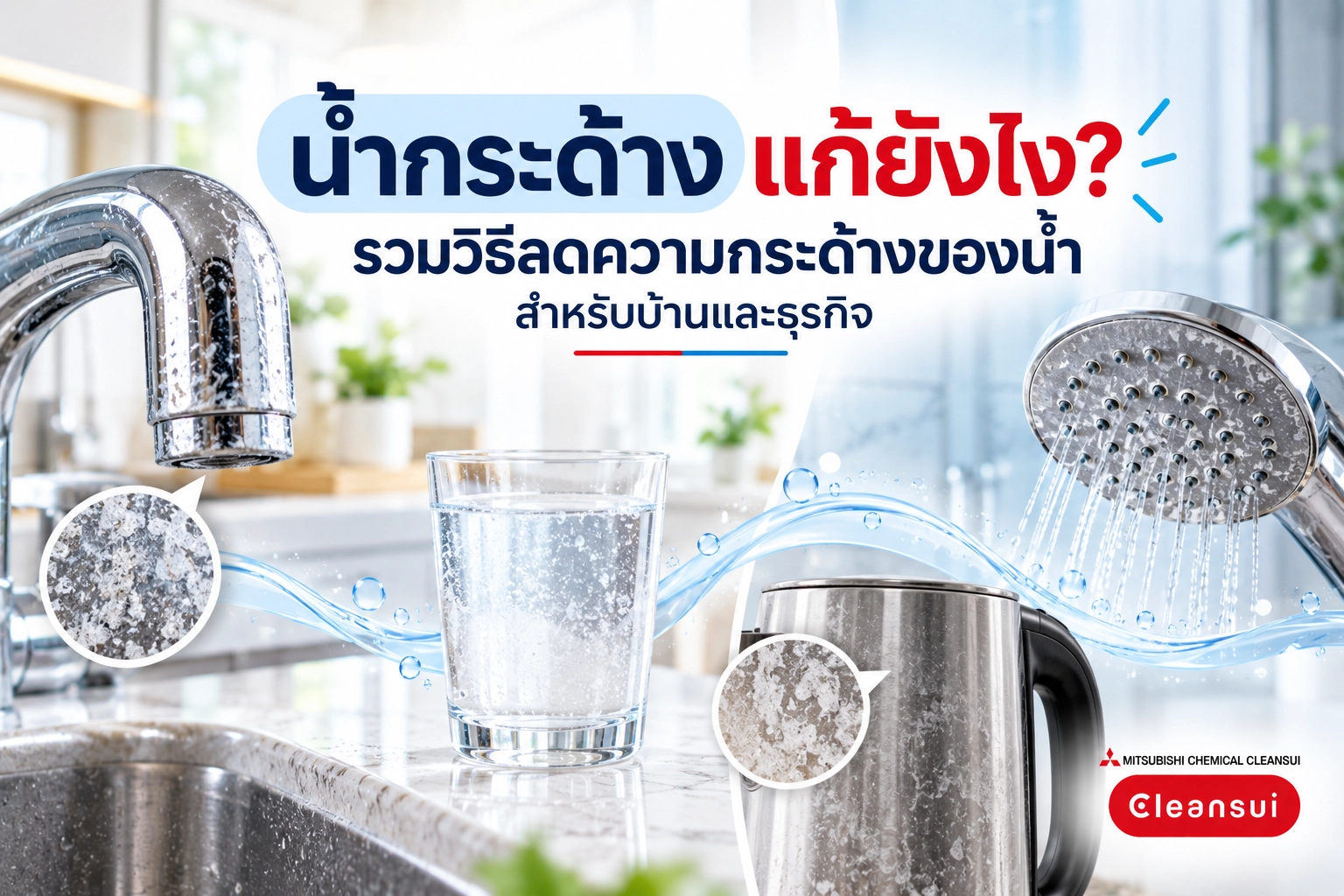
Hard water is one of the water quality problems many homes and businesses may have without realizing it, because it doesn’t stand out the way cloudy water or water that smells of chlorine does. But with regular use, you may start to notice white scale on faucets, sinks, glass or dishes, as well as buildup inside kettles, coffee machines, ice machines, water heaters and other equipment that uses water regularly.
The main cause of hard water is minerals dissolved in it, especially calcium and magnesium. When water is used or heated, these minerals can precipitate and form deposits, or scale. That’s why some businesses, such as coffee shops, restaurants, hotels and other establishments that use coffee machines and ice machines, put more emphasis on managing hard water than on simply filtering drinking water.
However, fixing hard water doesn’t mean every home or business needs the same kind of water purifier, because each type of filtration technology does a different job. A purifier that reduces chlorine odor or filters out sediment may not be designed to reduce hardness directly, while an ion exchange system, or Cation Exchange Resin, works on a principle better suited to dealing with the minerals that make water hard.
This article explains what hard water is, how to spot it, how to fix it, which methods can reduce water hardness, and which homes or businesses each method suits. It also covers how to choose a water purifier that fits your water problem, along with Cleansui’s solutions for uses that need to manage hardness and reduce scale.
What Is Hard Water?
Before answering how to fix hard water, you first need to understand that hard water doesn’t mean water with more dirt or germs than ordinary water. It means water with relatively high levels of certain dissolved minerals, especially calcium and magnesium.
When you use hard water in daily life, these minerals can cause noticeable problems, such as limescale or scale on surfaces. Equipment that is in contact with water for long periods can also build up scale, especially equipment that heats water.
Water hardness can be divided into several levels depending on the standard or measurement method used, so white deposits alone can’t tell you precisely how hard your water is. If you want to design a water treatment system for a home or business, test the actual water quality before choosing a technology. The key point is that hard water isn’t a problem every type of water purifier can solve equally well, so choose a treatment method that matches what you want to reduce in the water.
What Causes Hard Water?
Hard water is mostly related to the minerals that water comes into contact with or carries as it passes through soil and rock, especially in areas with mineral deposits or rock containing calcium and magnesium. As these minerals dissolve into the water, its hardness increases.
In tap water systems, hardness can vary by water source, treatment system and area, as well as by the condition of the plumbing inside the building itself. So don’t conclude from the name of an area alone that the water in your home or business must or must not be hard. Look at the water quality at the actual point of use instead, especially in buildings with water storage tanks, piping or other in-building equipment, since the condition of these systems can also affect the quality of the water that comes out of the tap.
How Can You Tell If Your Home Has Hard Water?
Many people start to wonder about hard water after seeing white deposits on faucets or other fixtures, but deposits alone can’t confirm how hard the water is. Still, there are several signs you can use as a starting point for checking.
1. White Deposits Build Up on Faucets
If white or hard deposits build up around faucets, showerheads or other fixtures that are regularly in contact with water, it may be related to minerals in the water and the precipitation of scale.
2. Scale in the Kettle
Appliances that boil water regularly tend to show buildup easily, because heat can cause certain minerals to precipitate more.
3. Buildup in the Coffee Machine
Coffee machines are another piece of equipment where water quality deserves attention, because water regularly passes through the machine’s internal systems and parts. If hardness is high, it can increase the chance of scale forming.
4. Deposits or Reduced Performance in the Ice Machine
Restaurants, cafés and hotels that run many ice machines should pay attention to water quality, because the equipment operates continuously and a large volume of water flows through the system.
5. Scale Buildup in Equipment That Uses Water and Heat
This problem occurs in many kinds of equipment, such as water heaters, water boilers, steamers or certain commercial appliances. However, these signs are only preliminary indicators. If you want to know how hard your water is, test the water quality with an appropriate method.
What Problems Does Hard Water Cause?
The effects of hard water that users commonly run into aren’t limited to keeping surfaces clean. They also involve the lifespan and upkeep of equipment that uses water, especially when hardness is high and the equipment is used continuously over a long period.
Scale on Surfaces
Minerals in water can build up as deposits on faucets, sinks, glass and other fixtures, so you have to clean more often.
Scale Inside Equipment
When minerals accumulate inside pipes or equipment components, they can form scale, which is a key concern for equipment that needs a continuous water supply.
More Upkeep for Appliances
Some equipment needs flushing or maintenance to deal with scale. If the water is very hard, maintenance may need to be more frequent or more involved.
Impact on Business Operations
For coffee shops, restaurants, hotels or businesses that run water through a lot of machinery and equipment, scale can become a cost in maintenance and downtime. So for businesses, managing hard water isn’t just about clean water; it’s also about water quality that suits their equipment and processes.
How Do You Fix Hard Water? What Are the Options?
There’s no single way to fix hard water that works in every situation, because the right method depends on how hard the water is, how much water you use, and what you use it for.
Common methods include:
- Using water-conditioning agents or products
- Ion exchange systems
- Reverse Osmosis (RO) systems
- Choosing a filter or treatment system dedicated to specific equipment
- Designing a business water treatment system based on usage volume
Each method works on different principles and has different limitations.
1. Reduce Hardness with a Cation Exchange Resin System
One method used to manage hardness is Ion Exchange — it uses ion exchange resin to exchange the ions linked to hardness, such as calcium and magnesium. This principle is clearly different from that of Activated Carbon.
Activated Carbon plays an important role in reducing chlorine, odors, tastes and certain substances, while ion exchange resin is used to deal with certain types of ions in water. That’s why, if your main concern is hard water, choosing a technology designed for hardness matters more than choosing a filter based on fine filtration alone.
Who Is It For?
This type of system suits applications that need to manage hardness and reduce scale, especially in businesses with water-using equipment, such as:
- Cafés
- Restaurants
- Hotels
- Commercial Kitchens
- Coffee machines
- Ice Machines
- Equipment That Uses Water and Heat
Cleansui’s Commercial series includes water purifiers that use Cation Exchange Resin + Activated Carbon — for example, MP02-5 and MP02-6 — which are designed to help manage hardness and reduce the problems it causes.
2. Use an RO Water Purifier
Another method many people think of when it comes to reducing minerals in water is Reverse Osmosis, or RO.
RO uses a semipermeable membrane and pressure to separate water from many dissolved substances, including certain solutes and ions, so it can reduce Total Dissolved Solids, or TDS, more effectively than ordinary filters. But that doesn’t mean RO is right for every situation.
One thing to consider is that RO systems produce wastewater during filtration and can also remove dissolved minerals from the water. So if your goal is to reduce hardness to protect a coffee machine or certain equipment, you don’t always need RO, because there are hardness-specific systems that may fit your needs better.
So RO is better suited to situations where you need to reduce many kinds of dissolved substances or TDS to meet your water quality needs, rather than being chosen just to fix hard water.
3. Use a Dedicated Whole-House Water Treatment System
If hard water affects the water used throughout the house, not just drinking water, you may need to consider a water treatment system installed before the water reaches the various points of use. This approach differs from a drinking water purifier installed only at the end of the faucet. For example, if you want to reduce scale problems affecting the following:
- Shower
- Water heater
- Faucet
- Washing machine
- Other water-using equipment
Installing a system at just one drinking water faucet won’t solve the problem across the whole system. So start by asking: do you want to fix hard water only for drinking, or for the whole house? The answer makes a big difference to the type of system you should choose.
4. Treat Hard Water at the Point of Use for Specific Equipment
For some businesses, solving the problem doesn’t require a large system for the entire building. If the problem only affects a coffee machine, an ice machine or certain appliances, installing a suitable treatment system just before that equipment may be a more effective approach. The advantage is that you can design the system to suit:
- The volume of water used
- Flow Rate
- The machine’s requirements
- Installation space
- How often it’s used
This approach is therefore well suited to businesses with specific equipment that want to control water quality before it enters the machine.
How to Choose a Water Purifier to Fix Hard Water
Once you know there are several ways to fix hard water, the next step is choosing a technology that matches the problem. Don’t choose based only on the finest filtration; ask what it is you need to reduce.
| Main issue | Technology to consider |
|---|---|
| Chlorine / odor / taste | Activated Carbon |
| Sediment and particles | Membrane / Sediment filtration |
| Certain bacteria | Membrane with suitable properties |
| Calcium / magnesium linked to hardness | Ion Exchange |
| TDS and many dissolved substances | RO |
| Scale Inside Equipment | Hardness management system suited to the equipment |
*This table doesn’t mean a technology can do only one job. You need to look at the product details and the performance the manufacturer specifies for each type of substance or contaminant.
Hard Water at Home: Which Fix Should You Choose?
For homes, the first thing to consider is whether hard water is a problem for the whole house or only for drinking water. If you only want to treat drinking and cooking water, a point-of-use filter may be enough. But if you want to reduce deposits or scale throughout the house, you need a system that can treat the water before it reaches multiple points of use.
Homes That Should Pay Special Attention to Hard Water
- Homes that often find white deposits on faucets
- Homes where kettles build up scale quickly
- Homes with water heaters at several points
- Homes that use well water
- Homes with a lot of water-using equipment
- Homes planning to install a coffee machine or other scale-sensitive equipment
However, if the main problem is hard water deposits on showerheads or water heaters, installing a single under-sink or faucet-mounted drinking water purifier may not be the answer, because it doesn’t treat the water flowing to other parts of the house.
How Do You Deal with Hard Water in a Condo?
For condos, the situation may differ from a house, because residents usually aren’t free to install large water treatment systems. If you only want to treat drinking and cooking water, a Point-of-Use water purifier is the more convenient option. But if you find deposits on faucets, showerheads or water heaters, you may first need to check whether the problem comes from the building’s water quality, its water storage tanks or the piping inside your unit. So in a condo, don’t rush to buy a water purifier just because you see white deposits; think about where you need to fix the problem and what you use the water for.
How Do You Fix Hard Water in a Coffee Shop?
Coffee shops are among the businesses that should pay special attention to water hardness, because water runs continuously through coffee machines and other equipment. If the water is very hard, scale inside the equipment is one of the issues to manage. But a coffee shop needs more than just clean water.
Water quality can affect all of the following:
- Scale prevention
- Coffee machine care
- The taste of drinks
- The amount of water used per day
- Flow Rate
- Cartridge replacement costs
- Equipment maintenance
So coffee shops should choose how to treat their water based on their actual water quality and the requirements of the coffee machines they use. If the main concerns are hardness and scale prevention, consider a system that uses Cation Exchange Resin specifically, such as Cleansui Commercial MP02-5 or MP02-6, depending on how it will be used and the volume of water.
How Do You Fix Hard Water in a Restaurant?
Restaurants use water differently from homes: they need water for drinking, cooking and washing ingredients, and to supply various equipment. So don’t choose a filter just by how many liters it can filter. Consider:
Water volume + Flow Rate + water quality + connected equipment + installation space
If your shop has coffee machines, ice makers or other scale-sensitive equipment, treat water hardness as a key factor when you design the system. For shops that need to manage hardness specifically, Cleansui's MP02-5 and MP02-6 are Commercial products that combine cation exchange resin with activated carbon; the manufacturer specifies them for preventing scale in steam-generating equipment such as steam convection ovens, steamers and humidifiers. For ice makers and cold drinking water, the manufacturer recommends the hollow fiber membrane models, the MP02-1 or MP02-4.
How Do Cleansui MP02-5 and MP02-6 Help with Hard Water?
Cleansui Commercial has products designed specifically for applications that need to manage hard water, unlike water purifiers that focus on general drinking water filtration.
MP02-5 and MP02-6 use the following technology:
Cation Exchange Resin + Activated Carbon
Cation Exchange Resin handles the exchange of the ions that make water hard, while Activated Carbon helps deal with certain substances, such as chlorine and odors, depending on the cartridge’s specifications. This brings hardness management and water filtration together in a single system.
MP02-5
MP02-5 has a capacity of about 5,000 liters and is designed for applications that need to manage hardness in larger volumes of water. It suits businesses with continuous water use that want to reduce scale in equipment such as steamers or Steam Convection Ovens, in line with the uses specified by the manufacturer.
MP02-6
MP02-6 has a capacity of about 3,000 liters. It works on the same concept as MP02-5 but is more compact and has a lower capacity, so it suits businesses or points of use that don’t need as much water as MP02-5, or where installation space is limited.
MP02-5 vs MP02-6: Which Should You Choose?
When choosing between these two models, don’t just ask which one is better; ask how much water you actually use and what equipment you want to connect it to.
| Feature | MP02-5 | MP02-6 |
|---|---|---|
| Technology | Cation Exchange Resin + Activated Carbon | Cation Exchange Resin + Activated Carbon |
| Capacity | 5,000 litres | 3,000 litres |
| Highlight | Handles more water | More compact |
| Best for | Businesses that use more water | Points of use with less water / limited space |
| Focus | Reducing hardness and preventing scale | Reducing hardness and preventing scale |
If your business uses a lot of water and wants to replace cartridges less often, MP02-5 may be the better fit. But if your water use isn’t very high or installation space is limited, MP02-6 may be more suitable. Either way, choose based on your water quality and the requirements of the equipment you’ll actually connect it to, not on capacity alone.
What Kind of Water Purifier Do You Need for Hard Water?
There’s no single model that suits everyone, because the term “water purifier” covers many kinds of technology. Depending on your goal:
- To reduce chlorine and odors, look for Activated Carbon.
- To filter out particles and certain contaminants, consider a Membrane with properties that match what you want to reduce.
- To reduce hardness and the chance of scale forming, consider Ion Exchange / Cation Exchange Resin.
- To reduce TDS or many kinds of dissolved substances, RO may be more suitable in some situations.
So the question to ask before buying isn’t “Which water purifier is best?” but “What’s wrong with our water, and what do we want to use it for?”
Hard Water and Tap Water: Do You Need a Water Purifier?
Not every area’s tap water needs a hardness-reduction system. If the water is suitable for your use and you have no scale problems, an extra hardness-reduction system may not be necessary. But if you notice limescale or have hardness-sensitive equipment, testing your water quality before designing a system can help you choose a more targeted fix.
This is especially true for businesses with expensive machinery or equipment: investing in water quality testing and choosing a suitable treatment method may help reduce maintenance problems in the long run.
How to Choose the Right Hard Water Fix for Your Home or Business
Before choosing a filter or water treatment system, we recommend considering 6 factors.
1. How Hard Is Your Water?
Test your actual water hardness if you want to design the system accurately.
2. How Many Points Need Treatment?
Are you treating only drinking water, or the water for the whole house/business?
3. How Much Water Do You Use per Day?
A single home and a single restaurant use very different amounts of water.
4. What Equipment Is Connected to the System?
Coffee machines, ice machines, Steam Ovens and other equipment may have different water quality requirements.
5. What Flow Rate Do You Need?
For businesses that use water at several points at once, Flow Rate matters more than cartridge capacity alone.
6. What Are the Long-Term Costs?
Don’t look only at the price of the unit; consider the cartridge price, replacement frequency, maintenance and all the costs associated with the system.
How Do You Fix Hard Water?
Hard water comes from minerals dissolved in water, especially calcium and magnesium, and can lead to deposits or scale in water systems and equipment, especially equipment that heats water or uses water continuously.
So when fixing hard water, don’t choose a filter based on fine filtration alone; choose a technology that matches the problem. If you want to manage hardness specifically, Cation Exchange Resin is one of the technologies to consider. RO can reduce many dissolved substances and ions, but it works on a different principle and comes with different considerations, such as wastewater and the removal of minerals from the water.
For businesses that want to reduce scale in their equipment, such as coffee shops, restaurants or commercial kitchens, choosing a water purifier means considering hardness, water volume, Flow Rate and equipment requirements together.
Cleansui Commercial MP02-5 and MP02-6 are options designed with Cation Exchange Resin together with Activated Carbon for applications that need to manage hardness, with capacities of 5,000 and 3,000 liters respectively. So the answer to “How do you fix hard water?” isn’t to pick the most powerful water purifier, but to choose the technology that best matches your water quality and how you actually use it.
FAQ: Frequently Asked Questions About Hard Water
How Do You Fix Hard Water?
Hard water can be managed in several ways, and the right method depends on the level of hardness and what the water is used for, for example Ion Exchange systems, Cation Exchange Resin, or RO when you need to reduce many kinds of dissolved substances. Test your water quality before choosing a treatment method.
Can a Water Purifier Reduce Hardness?
Some types of water purifiers can help reduce hardness, but not all of them, because each filtration technology is designed to deal with different substances or contaminants. If you want to reduce calcium and magnesium, choose a technology designed for hardness management.
Can Activated Carbon Fix Hard Water?
Activated Carbon’s main job is to deal with certain substances, such as chlorine, odors and tastes. It isn’t the main technology for reducing hardness from calcium and magnesium, so if hard water is your main concern, consider a system that uses Ion Exchange or a technology whose properties match the problem.
Can RO Reduce Water Hardness?
RO can reduce many ions and dissolved substances, including the components related to hardness, but it works differently from dedicated hardness-reduction systems and may produce wastewater during filtration. Choose based on your water quality goals and how you use the water.
Does Hard Water Really Cause Limescale?
Minerals associated with hardness can contribute to deposits or scale, especially when they precipitate and build up on surfaces or inside equipment.
Does Hard Water Affect Coffee Machines?
It can, especially when scale-forming minerals build up inside the coffee machine’s system. So coffee shops should consider their water quality and the coffee machine’s requirements before choosing a water treatment method.
Which Cleansui Model Suits Hard Water?
In Cleansui’s Commercial lineup, the models designed for hardness management are MP02-5 and MP02-6 — both use Cation Exchange Resin together with Activated Carbon. MP02-5 has a capacity of 5,000 liters, and MP02-6 has a capacity of 3,000 liters.
How do the MP02-5 and MP02-6 differ?
Both models use Cation Exchange Resin + Activated Carbon technology and are designed for applications that need hardness management. The main difference is capacity: MP02-5 has 5,000 liters and MP02-6 has 3,000 liters, so choose based on your water volume and installation space.
Does a Typical Home Need a Water Softener?
Not every home needs one. Consider your actual water quality, any scale problems you’ve found, and the equipment that uses water. If you don’t have a hardness problem or scale-sensitive equipment, a hardness-reduction system may not be necessary.
References:
Metropolitan Waterworks Authority (MWA), U.S. Geological Survey (USGS), U.S. Environmental Protection Agency (EPA)