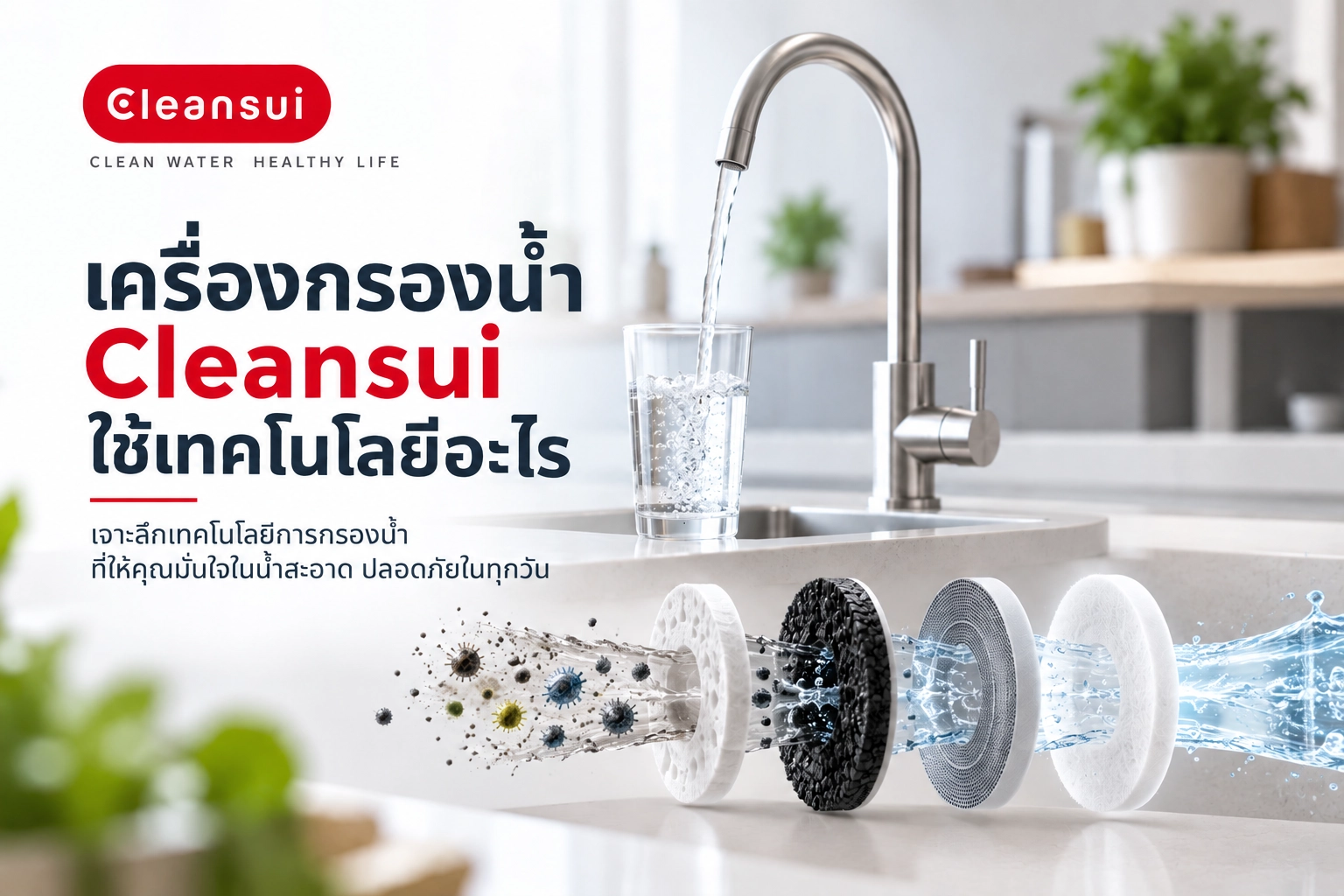
Many people shopping for a water purifier have probably come across the name Cleansui along with terms like Hollow-Fiber Membrane, Activated Carbon, UF, or multi-layer filtration. But when they look at the details of each model, they find that Cleansui cartridges don’t all use the same technology. So what technology do Cleansui water purifiers actually use?
The answer is that Cleansui uses several types of filtration technology, but the one at the heart of the brand is the Hollow-Fiber Membrane, a membrane made of hollow fibers. Mitsubishi has developed this technology continuously and pairs it with other filter media, such as Activated Carbon, Non-woven Fabric, and Ion Exchange Resin, depending on the purpose of each model.
Filtering water isn’t only about making it clear. You also need to consider which contaminants you want to remove, how much water you need, whether you want to keep the minerals, and what the filtered water will be used for. That’s why Cleansui doesn’t offer just one type of purifier, but a full range: faucet-mounted purifiers, pitchers, countertop and built-in models, and Commercial models for restaurants, cafés, hotels, and other businesses.
This article walks you through how each technology works and the differences between Hollow-Fiber Membrane, Activated Carbon, Ion Exchange, and multi-layer filtration, so you can understand what technology Cleansui water purifiers use and which technology suits which kind of use.
What Technology Do Cleansui Water Purifiers Use?
When it comes to Cleansui’s core technology, the first thing to know is the Hollow-Fiber Membrane (a membrane made of hollow fibers), the technology that sets Cleansui apart from water purifiers that use Activated Carbon alone. That said, a Cleansui cartridge may contain several different materials depending on the model. The key technologies you’ll typically find are:
- Hollow-Fiber Membrane – filters water through extremely small pores on the fiber surface to trap particles and certain microorganisms
- Activated Carbon – adsorbs certain substances, such as chlorine, odors, and organic compounds
- Non-woven Fabric – helps trap sediment and larger dirt particles before water reaches the other filter layers
- Ion Exchange Fiber / Ion Exchange Resin – exchanges ions and helps deal with heavy metals or hardness in systems designed for that purpose
- Multi-layer filtration – combines several technologies within a single cartridge
So if you ask what technology Cleansui uses, the most accurate answer is that Cleansui uses different filtration systems depending on the model. The Hollow-Fiber Membrane is one of the brand’s core technologies, and it usually works together with Activated Carbon or other filter media to deal with different types of contaminants.
What Is a Hollow-Fiber Membrane?
Hollow-Fiber Membrane consists of a large number of tiny, hollow, tube-like fibers whose surfaces are covered with extremely small pores.
A simple way to picture how it works is a sieve with very small openings, except that the membrane’s pores are far smaller than those of an ordinary sieve. As water passes through the membrane, contaminants larger than the pores are trapped, while water and certain substances smaller than the pores can pass through. This is why a Hollow-Fiber Membrane can deal with contaminants such as turbidity, sediment, rust, and certain microorganisms without using chemicals to filter the water.
One of this technology’s strengths is its large filtration surface area. A cartridge doesn’t contain just a single sheet of membrane but a great many fibers, which creates a large filtering area within a fairly compact space.
The brand’s Hollow-Fiber Membrane technology has pores as fine as 0.01 micron.
What Can a Hollow-Fiber Membrane Filter Out?
The membrane’s main job is to filter out contaminants that its porous structure can trap, such as:
- Turbidity
- Sediment
- Rust
- Certain microorganisms or bacteria
- Certain fine particles
- Contaminants that Activated Carbon alone can’t remove
The key point is that a Hollow-Fiber Membrane doesn’t do the same job as Activated Carbon, so you shouldn’t assume one technology can fully replace the other. That’s why many Cleansui models use Hollow-Fiber Membrane + Activated Carbon so that each layer handles a different type of contaminant.
What Is Activated Carbon, and What Does It Do?
Another key technology found in Cleansui water purifiers is Activated Carbon, also known as activated charcoal.
Activated Carbon has a highly porous structure, which gives it a large surface area and lets it adsorb certain substances from water. The role most people think of is dealing with residual chlorine and the unpleasant odors and tastes of tap water.
For example, tap water may contain residual chlorine from the disinfection process, which is important for the water supply system. In some cases, though, chlorine and odor-causing substances can affect how the water smells and tastes, and that’s where Activated Carbon comes in.
Activated Carbon can also be used to deal with organic compounds, pesticides, and certain other groups of substances, depending on the cartridge’s properties and each model’s test results.
How Is Activated Carbon Different from a Hollow-Fiber Membrane?
Here’s a simple way to understand the differences:
| Technology | How it works | Best for |
|---|---|---|
| Activated Carbon | Adsorption | Chlorine, odors, organic compounds, and certain other substances |
| Hollow-Fiber Membrane | Filtration through pores | Turbidity, sediment, rust, microorganisms, and certain particles |
| Ion Exchange | Ion exchange | Certain metals or hardness, depending on the type of resin |
| Non-woven Fabric | Physical trapping | Dust, sediment, and large particles |
Because each technology does a different job, combining several layers can deliver more comprehensive results than relying on a single filter medium.
Why Does Cleansui Combine a Hollow-Fiber Membrane with Activated Carbon?
This is the key to understanding Cleansui’s technology. Imagine that tap water contains:
- Chlorine and substances that affect odor
- Sediment
- Rust
- Turbidity
- Microorganisms
- Other contaminants
If you use Activated Carbon alone, it works well on certain groups of contaminants, but it doesn’t act as a fine sieve for particles and microorganisms the way a membrane does. Conversely, a Hollow-Fiber Membrane can trap particles based on its pore size, but it doesn’t do Activated Carbon’s job of adsorbing chlorine and certain substances. This led to the concept of Double Filtration — using two technologies with different roles. To put it simply:
Activated Carbon handles what needs to be adsorbed, while the Hollow-Fiber Membrane handles what needs to be filtered out. Working together, the two technologies let the filtration system deal with a wider variety of contaminants.
Does Cleansui Have a 4-Layer Filtration System?
Yes, but it’s important to understand that a 4-layer filtration system doesn’t mean every Cleansui model and cartridge has the same structure. Cleansui’s multi-layer filtration uses these main filter media:
1. Non-woven Fabric
This is the pre-filter layer that helps trap dirt and sediment, such as dust, fine particles, and rust. Its job is to reduce the load on the next filter layers.
2. Ion Exchange Fiber
This layer handles ion exchange and the adsorption of certain metal ions, such as lead, manganese, iron, and mercury. Its purpose is to add the ability to deal with contaminants that physical filtration alone can’t handle.
3. Activated Carbon
This layer focuses on adsorbing residual chlorine, odors, organic compounds, and certain other substances, which makes it especially important for how the water smells and tastes.
4. Hollow-Fiber Membrane
This is the membrane layer with extremely small pores. It filters out particles, turbidity, and certain microorganisms, according to the cartridge’s specifications. So a multi-layer system isn’t the same technology repeated over and over; each layer is responsible for a different type of contaminant.
How Is Cleansui’s Technology Different from Typical Water Purifiers?
Water purifiers on the market use many different technologies, and you shouldn’t judge them by the words “fine filtration” alone. What you should look at is how they filter and what they can remove.
For example, Activated Carbon handles chlorine and odors well, but it doesn’t work like a membrane.
UF (ultrafiltration) systems, on the other hand, focus on filtering through a membrane with extremely small pores.
Cleansui applies both approaches across several product lines, especially by combining a Hollow-Fiber Membrane with Activated Carbon in models that call for more than one type of filtration.
Another strength is that it’s designed to filter out contaminants while keeping some of the water’s natural minerals. That sets Cleansui apart from systems designed to remove dissolved substances from water at a high level, such as Reverse Osmosis (RO) systems, which work on a clearly different principle.
Does Cleansui Use RO (Reverse Osmosis) Technology?
In general, Cleansui’s home water purifiers and Commercial Series shouldn’t be lumped together as RO systems, because a Hollow-Fiber Membrane and Reverse Osmosis are two different technologies.
RO uses an extremely fine membrane and relies on pressure to push water through it, separating a large share of dissolved substances and ions from the water. Cleansui’s Hollow-Fiber Membrane, by contrast, focuses on filtering out particles and contaminants based on the membrane’s pore size, and is designed to let some of the minerals in the water pass through.
So if you want a water purifier that keeps the minerals in your water, it’s worth understanding the differences between these technologies before you buy.
So How Does Cleansui’s Technology Help Keep Minerals in the Water?
One of Cleansui’s key ideas is to filter out what you don’t want without having to remove everything in the water. Natural minerals such as
- Calcium
- Magnesium
- Potassium
- Sodium
differ in size and properties from the particles the membrane traps. So in a Hollow-Fiber Membrane system, water and sufficiently small substances can pass through the membrane, while particles larger than the pores are trapped.
This idea is how Cleansui positions its technology: filtering out contaminants while keeping the water’s natural minerals. However, “keeping minerals” shouldn’t be taken to mean that every Cleansui filtration system has exactly the same effect, because the structure and filter media differ from model to model.
What Technology Do Cleansui Commercial Water Purifiers Use?
For businesses, this matters a lot, because Cleansui Commercial models don’t all use the same type of cartridge. The MP02 Commercial Series can be grouped by technology as follows:
| Model | Main technology | Cartridge capacity |
|---|---|---|
| MP02-1 | Hollow-Fiber Membrane | 55,000 L |
| MP02-2 | Activated Carbon | 100,000 litres |
| MP02-3 | High-capacity Activated Carbon | 150,000 litres |
| MP02-4 | Activated Carbon + Hollow-Fiber Membrane | 50,000 litres |
| MP02-5 | Ion Exchange Resin + Activated Carbon | 5,000 litres |
| MP02-6 | Ion Exchange Resin + Activated Carbon | 3,000 litres |
These figures are filtration capacities according to the manufacturer’s data. They don’t mean each model is equally suited to every type of business. When choosing a model, consider water quality, how much water you use, the equipment to be connected to the system, and the problem you want to solve.
MP02-1 Uses a Hollow-Fiber Membrane: What Is It Best Suited For?
The MP02-1 is a Commercial model that mainly uses Hollow-Fiber Membrane technology. It can remove turbidity and microorganisms from tap water and has a filtration capacity of 55,000 liters.
What’s interesting is that the MP02-1 isn’t designed to remove chlorine, so it suits points of use where you want to retain the effect of residual chlorine. It’s a good example of why choosing a water purifier isn’t just about which model filters more finely, but about what properties you want the filtered water to have.
MP02-2 and MP02-3 Use Activated Carbon: How Do They Differ from MP02-1?
The MP02-2 and MP02-3 are Commercial systems that use Activated Carbon technology, and their strength lies in handling chlorine, odors, and certain substances that Activated Carbon is good at adsorbing. The main difference between the MP02-2 and MP02-3 is the volume of water they can handle:
- MP02-2: 100,000 liters
- MP02-3: 150,000 liters
That makes these two models well suited to uses that need a lot of water, such as restaurants, cafés, coffee machines, cooking, or water supply systems for various equipment. Just be sure to choose based on your actual usage.
What Technology Does the MP02-4 Use?
If you want the benefits of both Activated Carbon and a Hollow-Fiber Membrane, the model to look at is MP02-4
The MP02-4 uses a combined Activated Carbon + Hollow-Fiber Membrane + Non-woven Fabric system, providing multiple stages of filtration within a single system. Activated Carbon helps deal with chlorine and odors, while the Hollow-Fiber Membrane helps filter out turbidity and microorganisms according to the membrane’s properties. The MP02-4 has a filtration capacity of 50,000 liters.
This model is a clear example of the idea of combining adsorption + membrane filtration.
What Technology Do the MP02-5 and MP02-6 Use?
The MP02-5 and MP02-6 serve a different purpose from the MP02-1 through MP02-4. Both use Cation Exchange Resin together with Activated Carbon and Non-woven Fabric. The key point is that they’re designed to deal with water hardness, which involves minerals like calcium and magnesium. That makes them suitable for applications where scale buildup is a problem, especially equipment that uses steam, such as:
- Steamers
- Steam Convection Oven
- Equipment with heating systems
- Machines or equipment prone to scale buildup
The MP02-5 has a filtration capacity of 5,000 liters, while the MP02-6 handles 3,000 liters. So the MP02-5 and MP02-6 shouldn’t be seen simply as lower-capacity versions of the MP02-2 or MP02-3; they serve a different filtration purpose.
When Choosing a Cleansui Water Purifier, Which Technology Should You Look at First?
The answer depends on your water quality and how you use it. If your main concern is chlorine odor and the taste of the water, look for a system with Activated Carbon.
If you want to deal with turbidity, sediment, rust, and certain microorganisms, consider a system with a Hollow-Fiber Membrane.
If you want to deal with hardness and reduce scale buildup in your equipment, consider Ion Exchange Resin.
And if you want to tackle several types of problems at once, a Multi-Layer Filtration system that combines several materials may be the right fit. That’s why, without knowing how the water will be used, “Which Cleansui model is best?” can be harder to answer than “What problem does the water we want to filter have?”
What Kinds of Use Is Cleansui Technology Suited For?
With its wide range of filtration technologies, Cleansui offers products for quite a variety of uses.
Homes and Condos
Suited to anyone who wants to filter tap water for drinking, cooking, or kitchen use, with faucet-mounted, countertop, and built-in models available.
Restaurants and Cafés
The Commercial Series can be used in water systems for cooking, coffee machines, and other equipment, according to each system’s requirements.
Hotels and Service Businesses
You can choose the technology based on how much water you use and the type of equipment you need to supply water to.
Coffee machines
Water quality affects both taste and mineral buildup inside the machine, so consider both the filtration technology and the quality of your source water rather than choosing on filtration capacity alone.
Ice Machines
Water used to make ice should be treated in a way that suits the source water quality and the machine’s requirements, so when choosing a commercial filter, look at both the flow rate and the cartridge’s properties.
Is Filtration Technology More Important Than the Number of Filter Layers?
More layers aren’t always necessary. Having more filter layers doesn’t mean a purifier suits everyone better, because each layer does a different job.
For example, if your water has a high-hardness problem, adding more Activated Carbon or a Hollow-Fiber Membrane may not solve scale problems as directly as an Ion Exchange system designed to deal with hardness.
If you want to deal with turbidity and microorganisms, choosing a system with a Hollow-Fiber Membrane may matter more than simply adding more Activated Carbon. So the principle to follow is to match the technology to your water’s problem rather than looking only at the number of filter layers.
What Is the History of Cleansui’s Hollow-Fiber Membrane?
Hollow-Fiber Membrane technology has been with Cleansui for a long time. It started with Mitsubishi Rayon (which later became Mitsubishi Chemical) developing fibers for water and blood filtration. In the 1970s, researchers discovered a porous structure on tube-like fibers and developed the idea into a membrane for filtration.
Hollow-Fiber Membrane technology went on to be used in many industries, including medicine, and in 1984 Cleansui brought it to household water purifiers. So it’s no surprise that whenever Cleansui’s technology comes up, the name Hollow-Fiber Membrane has always been mentioned alongside the brand.
Does Cleansui Filtration Remove the Minerals?
One common misconception about water purifiers is that “fine filtration = all minerals gone.” In reality, it depends on the technology used.
Cleansui’s Hollow-Fiber Membrane system is designed to filter particles based on the membrane’s pore size, while some dissolved substances and minerals can pass through. That makes it different from certain filtration systems designed to separate dissolved substances and ions from water at a high level. However, if you want to know what a particular cartridge can remove, check that model’s specifications and test results directly, because each cartridge uses different materials and structures.
How to Choose a Cleansui Water Purifier by Its Technology
Before you buy, start with these 5 questions:
1. What do you want to filter out?
Do you want to reduce chlorine, odors, turbidity, rust, microorganisms, heavy metals, or hardness?
2. How much water do you use per day?
Homes and restaurants use very different amounts of water, so the cartridge’s filtration capacity is an important factor.
3. What flow rate do you need?
For businesses that use water continuously, flow rate matters just as much as filtration capacity.
4. What will the filtered water be used for?
Drinking water, cooking water, coffee machines, ice machines, or steamers may each need water with different properties.
5. What problems does your source water have?
If your water is very hard, choosing a purifier just because it claims “fine filtration” may not be enough. Once you know the answers to these questions, you can choose the model with the most suitable technology.
What Technology Do Cleansui Water Purifiers Use?
Cleansui doesn’t use just one type of filtration technology; it has several filtration systems to suit each product’s purpose. The technology that is unique to Cleansui and at its heart is the Hollow-Fiber Membrane — it filters out particles, turbidity, rust, and certain microorganisms according to the membrane’s properties.
Meanwhile, Activated Carbon helps adsorb chlorine, odors, and certain substances, while Ion Exchange is used in some product lines to deal with hardness and reduce scale buildup. Cleansui’s technology can therefore be summed up as follows:
Hollow-Fiber Membrane = focuses on physical filtration
Activated Carbon = focuses on adsorbing chlorine, odors, and certain substances
Ion Exchange = focuses on exchanging ions and dealing with hardness in purpose-designed systems
Multi-Layer Filtration = combines several technologies to deal with many types of contaminants
So if you’re choosing a Cleansui water purifier, the important thing isn’t just to ask which model filters best, but first to ask what problems your water has and what you want to use it for.
Once you understand the technology, choosing a model such as the EF Series for faucet-mounted use, a built-in model for the kitchen, or the MP02 Commercial for restaurants and businesses becomes easier and better matched to how you’ll actually use it.
FAQ
Does Cleansui Use UF?
Yes. In principle, Cleansui’s Hollow-Fiber Membrane falls under ultrafiltration (UF), according to Waterclick. It uses a hollow fiber membrane with small pores to filter out particles and contaminants according to the cartridge’s specifications.
What’s the Difference Between a Hollow-Fiber Membrane and Activated Carbon?
A Hollow-Fiber Membrane filters through pores to trap particles and contaminants by size, while Activated Carbon adsorbs substances such as chlorine, odors, and certain organic compounds. The two do different jobs and can be used together.
Does Cleansui Filter Out Chlorine?
It depends on the model. If the cartridge contains Activated Carbon, it can be designed to deal with residual chlorine, but you shouldn’t assume this applies to every Cleansui model. For example, the MP02-1 is a model the manufacturer states does not remove chlorine.
Does Cleansui Filter Out Bacteria?
Models that use a Hollow-Fiber Membrane can filter out certain microorganisms or bacteria, according to each product’s specifications and test results. But this shouldn’t be taken to mean that every purifier can remove every type of germ or replace disinfection.
Can Cleansui Filter Hard Water?
Some models, particularly the MP02-5 and MP02-6, are designed to deal with hardness using Ion Exchange Resin, so they suit uses that need to reduce calcium and magnesium and help reduce scale problems.
Do Cleansui Water Purifiers Need Electricity?
Many Cleansui models use tap water pressure to filter and don’t need an electric pump for the filtration process. However, each product type may have different systems or accessories, so check the model’s details before installation.
Are Cleansui Water Purifiers Suitable for Restaurants?
Yes. Cleansui has a dedicated Commercial Series, such as the MP02-1 to MP02-6, which lets you choose the technology based on your water and how you use it, such as drinking water, cooking, coffee machines, ice machines, or equipment with scale problems.