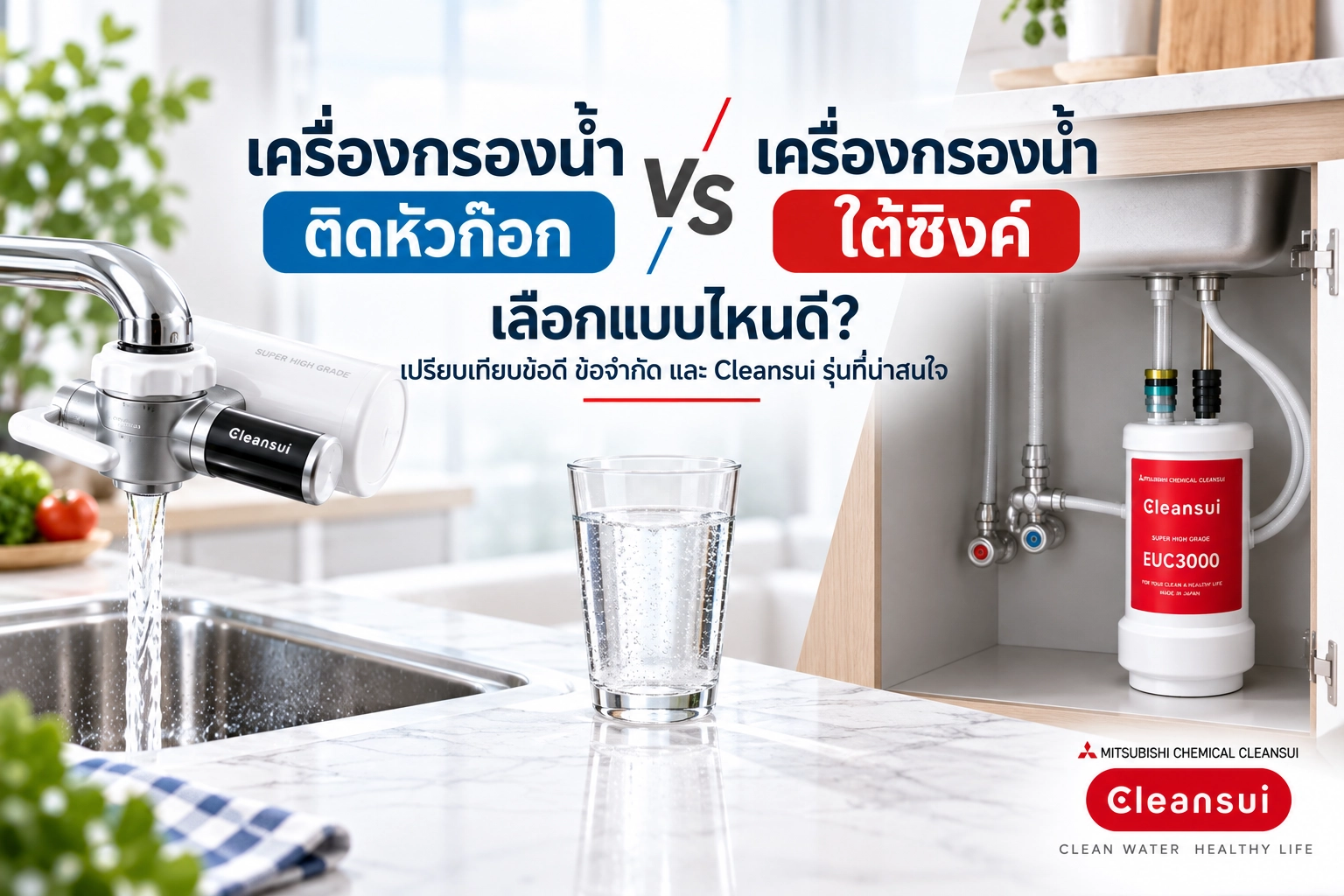
When choosing a water purifier for your home, many people start by asking which model is best. But there’s another question you should answer first: should you go with a faucet-mounted water purifier or one installed under the sink? The two types work quite differently, even though they ultimately share the same goal of filtering tap water before you drink it or cook with it.
Faucet-mounted water purifiers stand out for their compact size, easy installation and the fact that they don’t require major changes to your kitchen. They suit condos, rental homes, dorms or any home that wants a water purifier without drilling the counter. Under-sink (or built-in) water purifiers put the filter under the counter, leaving only a filtered-water faucet on top, so the sink area looks tidy and there’s no unit attached to the main faucet.
Cleansui offers products in both groups, such as the EF Series in the faucet-mounted group and the EU Series in the built-in group, so you can choose based on your home and how you use water. But which type suits you better? The answer doesn’t depend on which one is better overall; it depends on your installation space, how much water you use, how easy installation is, how tidy you want your kitchen to be, and your budget. This article compares faucet-mounted and under-sink water purifiers in detail, with examples of Cleansui models worth a look, to help you decide more easily.
Faucet-Mounted vs Under-Sink Water Purifiers: What’s the Difference?
The most obvious difference is where the purifier is installed. A faucet-mounted water purifier attaches to the end of your existing faucet: tap water flows into the filter, and you can then choose filtered water or tap water, depending on the product. An under-sink water purifier places the filter under the counter and connects it to a separately installed faucet for filtered water. Simply put:
Faucet-mounted = the filter sits on top, attached to the faucet
Under-sink = the filter is hidden below, with a separate filtered-water outlet coming up top
Both types can deliver a good user experience, but they suit different situations.
Comparing Faucet-Mounted and Under-Sink Water Purifiers
Before getting into the details, let’s look at the big picture first.
| Feature | Faucet mounted | Under-sink |
|---|---|---|
| Installation | Easier | Requires an under-counter installation |
| Drilling the counter | Usually not needed | Usually needs a spot for the filtered-water faucet |
| Counter space | Uses little space | Leaves more space on top |
| Filter | Sits at the faucet | Hidden under the sink |
| Kitchen tidiness | Unit sits on the faucet | Looks tidier |
| Removal and relocation | Easier to do | Not as convenient |
| Suits rental homes | Suitable | Check installation restrictions |
| Suits condos | Suitable | Suitable if there’s space and it can be installed |
| Suits long-term homes | Suitable | Very suitable |
| Cartridge capacity | Depends on the model | Depends on the model |
| Heavy water use | Choose a suitable model | Some models are designed for continuous use |
| Upfront budget | Usually lower | Usually higher |
This table doesn’t mean one system is better than the other; it shows that the two systems are designed for different needs.
What Is a Faucet-Mounted Water Purifier?
A faucet-mounted water purifier is a system that attaches a filter to the faucet you already have. When you turn on the water, you can choose a water mode the unit supports, such as filtered water or regular tap water. The immediate advantages are that you don’t need to change much of your kitchen’s plumbing, and with some models you don’t need to install a separate filtered-water faucet.
Cleansui has several faucet-mounted water purifiers, such as EF101, EF102 and EF103. These models are examples of purifiers designed to be installed at the faucet, with a fairly compact size.
For example, EF102 uses the EFC11 cartridge, with a capacity of 900 liters and a flow rate of 1.6 liters per minute, so it suits people who want filtration for household use without a big under-sink installation job.
Advantages of Faucet-Mounted Water Purifiers
The biggest advantage is easy installation. If your existing faucet meets the unit’s installation requirements, you can attach the filter to it without re-plumbing the whole system. Another is that it suits limited spaces: in condos, small rooms or compact kitchens, having the filter at the faucet can be more convenient than installing a large system under the sink. It’s also a good fit for renters who may not be allowed to drill the counter or modify the plumbing.
Faucet-Mounted Highlights
- Easy to install
- Uses little space
- No large unit taking up the counter
- No need to drill the counter for a standard installation
- Easier to remove and relocate
- Suits condos and rental homes
- Unit prices generally start at a more affordable level
- Suits people who want an uncomplicated filtration system
That said, there’s one thing to check before buying: whether your faucet at home can take the unit.
Limitations of Faucet-Mounted Water Purifiers
Although they’re easy to install, faucet-mounted purifiers do have limitations.
First, the unit sits right on the faucet. If you like a minimalist kitchen or want the area around your sink as clear as possible, a unit attached to the faucet may make the kitchen feel less tidy than an under-sink system.
Second, you need to check compatibility with your faucet. Some types of faucet can’t take the unit directly or may need an extra adapter.
Third, cartridge capacity depends on the model.
For example, EF102 uses EFC11, which has a capacity of 900 liters. So if yours is a larger household that uses a lot of filtered water, compare your actual water use with the cartridge’s capacity before buying.
What Is an Under-Sink Water Purifier?
An under-sink water purifier is a system with the filter installed under the sink or kitchen counter, leaving only a faucet for filtered water on top of the counter. The core idea is to move the filter out of the working area on the counter.
Cleansui calls this system “built-in,” and its lineup includes models like EU101 — designed with the filter installed under the counter and a separate faucet for filtered water. EU101 uses the EUC2000 cartridge, with a capacity of 8,000 liters and a flow rate of about 2.8–3 liters per minute. So under-sink doesn’t just mean “hiding a purifier under the sink”; it’s an installation style designed to make the filtration system more of a part of the kitchen.
Advantages of Under-Sink Water Purifiers
The most obvious advantage is a clean, uncluttered counter. The filter is hidden under the sink, so there’s no unit attached to the main faucet. For people who cook regularly, this matters a lot, because the sink is an area you use constantly. Another advantage is that you can position the filtered-water faucet to suit your kitchen.
If you’re building a new house or renovating your kitchen, planning an under-sink system from the start is easier, because you can prepare the faucet position, water pipes and space for the cartridge all at once.
Under-Sink Highlights
- Filter hidden under the counter
- Tidy-looking counter
- No filter attached to the main faucet
- Suits built-in kitchens
- Suits homes for long-term use
- Some models handle more water than many faucet-mounted units
- The filtered-water faucet can be designed to match your kitchen
- Suits people who want to keep filtered water separate from everyday tap water
Limitations of Under-Sink Water Purifiers
The main limitation is that installation is more involved, especially in homes where the kitchen is already finished. If there’s no opening for a filtered-water faucet yet, you may need to drill the counter to add one. You also need enough space under the sink for the filter unit and pipes, so check the space before buying. Don’t just look at the size of the unit, because the space under your sink may also hold:
- Water supply pipes
- Drain pipes
- Trash bin
- Odor trap
- Storage shelves
- Under-sink water heater
- Other kitchen equipment
If there’s little space left, the installation may make it hard to reach the cartridge when you need to replace it later. So the space for cartridge replacement is another thing to plan before installing.
Faucet-Mounted vs Under-Sink: Is There a Difference in Water Quality?
The answer is that you shouldn’t judge by installation type alone. The quality of filtered water depends on the cartridge technology, the product model, the quality of the source water and using the unit as the manufacturer specifies. For example, Cleansui’s EF Series and EU Series use different cartridges: EF102 uses EFC11 with a capacity of 900 liters, while EU101 uses EUC2000 with a capacity of 8,000 liters.
So the difference between the two systems doesn’t come down to the words “faucet-mounted” or “under-sink” alone; you also need to look at each model’s cartridge and specs. Hollow-Fiber Membrane technology is one of the key technologies in filtration systems, and the brand’s products can be designed with multiple filtration stages depending on the model.
Faucet-Mounted vs Under-Sink: Which Filters More Water?
When it comes to how much water a cartridge can filter, you need to compare model to model, not type to type. Examples from Cleansui:
EF102 + EFC11 = 900 liters, while
EU101 + EUC2000 = 8,000 liters
So you can see that EU101 has a far higher cartridge capacity than EF102. But that doesn’t mean every under-sink purifier filters more than every faucet-mounted one, because each model has a different cartridge and intended use. So if your household uses a lot of filtered water, look at the Filter Capacity figure as one of the main factors.
So Why Does Flow Rate Matter?
Besides cartridge capacity, another figure to check is Flow Rate, or how fast the water flows. For example:
- EF102: 1.6 L/min
- EU101: approx. 2.8–3 L/min
If you only use filtered water to fill a glass or a small bottle, you may not notice much difference. But if you use filtered water to:
- Fill pots
- Cooking
- Fill several bottles
- Prepare drinking water for several people
In those cases, Flow Rate starts to affect how convenient it is to use. So don’t just look at how many liters the cartridge filters over its life; also look at how fast the water flows when you turn it on.
Is a Faucet-Mounted Purifier Right for a Condo?
Yes, especially for condos with limited kitchen space or residents who don’t want to modify their room. The advantage of faucet-mounted is that it can be fitted to a compatible faucet and doesn’t take up much space under the sink. If you rent your condo, you also have the advantage of being able to remove it and take it with you when you move. However, check before buying whether your condo’s faucet can take it, because some types of faucet can’t be fitted directly.
What Kind of Home Suits an Under-Sink Purifier?
Under-sink suits homes planning long-term use that care about a tidy kitchen, especially homes with:
- A built-in kitchen
- Enough space under the sink
- Counter space you want to keep clear
- Regular use of filtered water
- Several household members
- Regular cooking
If you’re already building a house or renovating your kitchen, preparing the plumbing for an under-sink purifier from the start is more convenient.
Should a Rental Home Go Faucet-Mounted or Under-Sink?
For a rental home, what matters is how easy it is to install and remove. That’s why a faucet-mounted purifier is usually the better fit here: in many cases you don’t need to drill the counter or replace the main faucet. But if your landlord allows a permanent installation and the home has suitable space, under-sink is also an option. The key is to check the installation terms with your landlord first, especially if you’d need to drill the counter or add a filtered-water faucet.
If You Live in a Condo and Cook Every Day, Which Should You Choose?
Here you need to weigh two factors together: space and water use. If the kitchen is tight and you want easy installation, faucet-mounted is the straightforward choice. But if your condo has a built-in kitchen with enough space under the sink, an under-sink installation can keep the faucet area looking cleaner and suits people who use more filtered water.
So “condo = must be faucet-mounted” isn’t a hard rule.
If You Cook Every Day, What Advantages Does Under-Sink Offer?
People who cook often use more water than just for drinking. You may need water for:
- Boiling
- Rinsing ingredients
- Fill pots
- Making drinks
- Preparing food
So a system that delivers filtered water conveniently, with a suitable Flow Rate, makes kitchen work easier. Hiding the filter under the sink also keeps the area around the faucet free of the unit. That’s why under-sink tends to suit homes that use their kitchen seriously.
What If You Have Little Space Under the Sink?
Don’t rush to decide based on the word “under-sink” alone. Open up the space under your sink and take a real look first, then measure:
Width × depth × height
Then check where the pipes are and the space for removing the cartridge. What matters isn’t just whether the filter fits, but also whether you’ll be able to take it out when it’s time to replace the cartridge. If the filter sits against the wall or is blocked by pipes so you can’t get it out, the installation could cause problems in the long run.
Cartridge Replacement: Which Type Is More Convenient?
Both systems allow cartridge replacement, but access differs. With faucet-mounted, the filter is on top and easy to see, so it suits people who want to check its status and replace the cartridge themselves. With under-sink, the filter is under the counter, so you have to get into the space under the sink to replace it.
That said, Cleansui’s under-sink system has the advantage that the filter doesn’t need to sit in the working area up top. The under-sink system has a structure that doesn’t leave the cartridge under water pressure all the time, which helps reduce the risk of pressure remaining at the filter, as can happen in some systems. However, after a cartridge change, some water may drip out for a while, depending on how the system is built.
How Do Costs Compare Between Faucet-Mounted and Under-Sink?
Generally, faucet-mounted has a lower upfront cost. For example, EF102’s latest listed price is 4,390 baht, while EU101 is 23,800 baht, according to Waterclick’s most recently checked data. But don’t compare only the price of the unit. Look at:
- Price of the unit
- Cartridge Price
- Cartridge capacity
- Replacement cycle
- Cost of installation parts
- Installation labor, if any
- Long-term costs
For example, EU101 uses EUC2000 with a capacity of 8,000 liters, while EF102 uses EFC11 with a capacity of 900 liters. So a higher price for one system doesn’t mean the cost to filter 1 liter is proportionally higher.
If You Don’t Want to Drill Your Counter, Which Should You Choose?
The answer is pretty clear: choose a faucet-mounted water purifier, since it’s designed to attach to your existing faucet, possibly with an adapter depending on the faucet type. But check your faucet’s compatibility before installing.
If You Want a Minimalist Kitchen, Which Is Better?
If the look of your kitchen is your top priority, under-sink has the edge in hiding the unit. The filter sits under the counter, leaving only a faucet for filtered water.
Cleansui built-in or under-sink water purifiers help keep the kitchen looking clean and organized, while faucet-mounted ones focus on convenience and easy installation. So for a thoughtfully designed kitchen, such as a built-in or modern kitchen, an under-sink installation usually fits the overall look of the room better.
On a Tight Budget, Which Should You Choose?
If budget is your main constraint, faucet-mounted offers more affordable options. For example, the Cleansui EF Series comes in several price tiers, and some models currently cost under 5,000 baht, whereas under-sink systems like EU101 cost much more for the unit.
So if your goal is to start using a water purifier without investing in a permanent installation yet, faucet-mounted is the easier starting point. But for a home you plan to live in long-term, with a budget for installation, investing in an under-sink system is another way to go.
Which Cleansui Faucet-Mounted Models Are Worth a Look?
In the faucet-mounted group, you can start with the EF Series.
Cleansui EF101
Suits people who want a compact faucet-mounted water purifier that uses the EFC11 cartridge. It’s an option for people who value simplicity and general household use.
Cleansui EF102
Also uses EFC11, with a capacity of 900 liters and a flow rate of 1.6 liters per minute, plus a digital display for usage information.
Cleansui EF103
Another faucet-mounted option that also uses EFC11, suited to people comparing the functions and design of the EF Series.
When choosing within this group, don’t just look at filtration capacity; consider which unit design and functions fit how you’ll actually use it.
Which Cleansui Under-Sink Water Purifiers Are Worth a Look?
For a typical home, one model worth a look is Cleansui EU101 with the EUC2000 cartridge, an 8,000-liter capacity and a design that puts the filter under the counter. EU101’s highlights are that no counter space is needed for the purifier and filtered water is delivered through a dedicated faucet, which makes it a good fit for:
- Homes planning long-term use
- Homes that cook regularly
- Families
- A built-in kitchen
- People who want a clear counter
- People who want a high-capacity cartridge
However, you need space for installation and should plan the faucet setup properly before installing.
Comparison Table: Cleansui EF102 vs EU101
To see the difference in concrete terms, compare these two models.
| Features | Cleansui EF102 | Cleansui EU101 |
|---|---|---|
| Type | Faucet mounted | Under-sink |
| Cartridges | EFC11 | EUC2000 |
| Capacity | 900 L | 8,000 liters |
| Flow Rate | 1.6 L/min | Approx. 2.8–3 L/min |
| Filter location | At the faucet | Under the counter |
| Counter space | Unit sits at the faucet | More clear space |
| Installation | Easier | Requires under-sink installation |
| Removal and relocation | Easier | More complex |
| Best for | Condos/rentals/general use | Houses/built-in kitchens/long-term use |
| Latest checked price | 4,390 baht | 23,800 baht |
Prices are a snapshot as of the date checked and may change with promotions.
The clear takeaway is that EU101 isn’t just an EF102 hidden under the sink; it’s a system with a different cartridge, capacity and installation style.
Faucet-Mounted vs Under-Sink: Which Saves More?
If you look only at the upfront investment, faucet-mounted purifiers are usually cheaper. But for the long-term cost of use, you need to factor in cartridge capacity and cartridge price too. For example:
Cost per liter = cartridge price ÷ filtration capacity
Then compare that with how much water your household actually uses. This is more accurate than saying “model A is cheaper,” because two purifiers may differ a lot in price but also differ several-fold in cartridge capacity.
Faucet-Mounted vs Under-Sink: Which Is Easier to Maintain?
In terms of reaching the filter alone, faucet-mounted is easier, since the filter is where you can see and reach it. But in terms of a tidy workspace, under-sink has the edge, since the filter isn’t at the faucet. So “easy to maintain” needs to be split into two things:
Easy cartridge replacement → faucet-mounted
Easy kitchen organization → under-sink
Faucet-Mounted vs Under-Sink: Which Suits Homes With Children?
Homes with children should pay special attention to tidiness and ease of use. Under-sink has the advantage that the filter and most of the pipes are tucked under the counter, so the faucet area looks clearer. But faucet-mounted is also convenient to use and has advantages in installation and maintenance.
So consider this together with your faucet type and the actual space in your kitchen, rather than choosing on this factor alone.
5 Questions to Ask Yourself Before Choosing
If you still can’t decide, try answering these questions.
1. Do You Own Your Home or Rent?
If you rent, faucet-mounted is usually easier to install.
2. Do You Want to Drill Your Counter?
If you don’t want to drill, start by looking at faucet-mounted.
3. Do You Have Space Under the Sink?
If you have space to spare and want a long-term system, under-sink is an attractive option.
4. How Much Filtered Water Do You Use per Day?
If you use a lot of water, look at both Filter Capacity and Flow Rate.
5. How Much Do You Care About a Tidy Kitchen?
If you want a clear counter and would rather not see the filter, under-sink has the edge.
Faucet-Mounted vs Under-Sink Water Purifiers: Which Should You Choose?
There’s no single answer for every home, because faucet-mounted and under-sink water purifiers are designed for different ways of using them.
Faucet Mount suits people who want simplicity, easy installation, a small footprint and easy relocation, without major changes to the kitchen. It’s a good fit for condos, rental homes, dorms or homes with moderate filtered-water use.
Under-Sink Water Purifier suits people who want a tidy kitchen, want to hide the filter under the counter, use filtered water regularly and are looking for a system installed for long-term use.
Taking Cleansui as an example, the EF Series (such as EF101, EF102 and EF103) suits people who want a faucet-mounted system, while EU101 is an under-sink option that uses the EUC2000 cartridge with a capacity of 8,000 liters and is designed with the filter under the counter. So the simplest way to choose is:
Condo / rental home / don’t want to drill → faucet-mounted
Own home / built-in kitchen / want a clear counter → under-sink
Light water use → look at faucet-mounted models with suitable capacity
Heavy water use → look at both cartridge capacity and Flow Rate
Easy installation first → faucet-mounted
Tidiness and long-term use first → under-sink
In the end, don’t choose based on which type is “best.” Choose based on your kitchen layout, how much water you use and how your household lives, because the best water purifier is the one you can use conveniently and keep maintaining in practice.
FAQ: Frequently Asked Questions
Which Is Better, a Faucet-Mounted or Under-Sink Water Purifier?
No single type suits every home. Faucet-mounted purifiers stand out for easy installation and saving space, while under-sink ones stand out for tidiness and hiding the filter under the counter. Choose based on your space and how you use water.
Is a Faucet-Mounted Water Purifier Suitable for a Condo?
Yes, especially in condos with limited kitchen space or where you don’t want to drill the counter. However, check whether your existing faucet can take the purifier.
Does an Under-Sink Water Purifier Require Drilling the Counter?
Generally, an under-sink installation with a separate filtered-water faucet needs a spot on the counter to install the faucet, but the details depend on the model and kitchen layout.
Does a Faucet-Mounted Water Purifier Filter Less Than an Under-Sink One?
You can’t conclude that from the installation type. You need to look at each model’s cartridge capacity: for example, EF102 uses EFC11 with a capacity of 900 liters, while EU101 uses EUC2000 with a capacity of 8,000 liters.
What’s the Difference Between Cleansui EF102 and EU101?
EF102 is a faucet-mounted water purifier that uses EFC11 with a capacity of 900 liters and a flow rate of 1.6 liters per minute. EU101 is an under-sink system that uses EUC2000 with a capacity of 8,000 liters and a flow rate of about 2.8–3 liters per minute.
Which Type of Water Purifier Should a Rental Home Choose?
Generally, faucet-mounted is the better fit, because it’s easier to install and remove and usually doesn’t require modifying the counter. But check faucet compatibility before buying.
Is an Under-Sink Water Purifier Good for People Who Cook?
Yes, especially for homes that cook regularly and use a lot of filtered water, because the filtered-water faucet is separate from the main faucet, and some models have a higher capacity and Flow Rate than some faucet-mounted units.
Which Type of Water Purifier Is More Economical?
If you look only at the initial purchase price, faucet-mounted usually costs less. But to compare long-term value, factor in the unit price, cartridge price, capacity and water use together.
If You Don’t Want the Purifier on Your Faucet, Which Should You Choose?
Choose an under-sink or built-in model, because the filter is installed under the counter with a separate filtered-water faucet, so the area around the main faucet looks clearer and tidier.